
By Mindy McDonald, CSJP
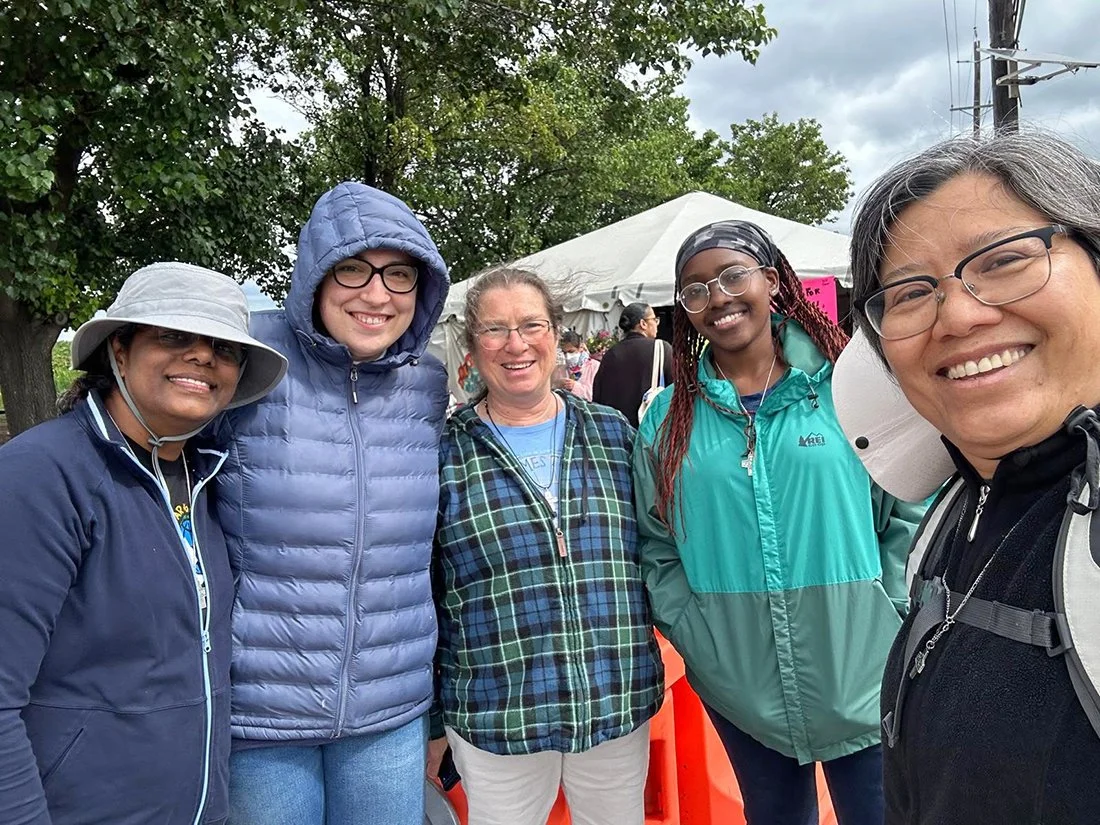
Sheena George, CSJP, Matea Korsa, Mindy McDonald, CSJP, Cheruto Bundi, CSJP, Anna Nguyen.
In 2025, the Department of Homeland Security reopened Delaney Hall as an ICE detention facility in Newark, New Jersey, in a heavily industrial section of the city. ICE agents took people from their regularly scheduled court appointments, or from their legal jobs, and locked them up. People who were following the rules to live and work in this country had, overnight, become “illegals” and “criminals.”
Injustice leads to unrest, and I certainly felt unrest in my heart. Our charism of Peace through Justice commits us to action on behalf of justice. I learned that a few people were going to Delaney weekly to protest, so I made a sign and drove to Newark one day in June.
“Chemical Alley,” as the area is known, is notorious for the density of active contamination sites, from sewage treatment plants to chemical waste facilities to gas storage tanks, and the air reeked that day. Delaney sits on Doremus Avenue, a four-lane truck route (1 and 9). I joined three other women in waving at the truck drivers and motioning for them to honk their horns, to communicate to those held inside Delaney Hall that they were not forgotten. As the days and weeks passed, we hardly needed to ask; the truckers would wave and blow their horns as they passed the facility.
On visiting days, families were told to register with the guard at the gate at least one hour prior to the visit time scheduled for the detainee's unit. Since there was no indoor waiting area, everyone waited in the wide, active driveway in front of the facility. Volunteers brought water to give out, because the families were not prepared to wait on the asphalt in the hot summer sun. Soon, volunteers gathered beach chairs and umbrellas, along with clothing for visitors to borrow so that they would meet the dress code. A group chat was set up, and community grew around identifying and meeting the families’ needs. “Could someone bring large sweats, please? Visitors wearing shorts don’t get in.” Sweats would appear. Families knew that ordinary people, their neighbors, were supporting them.
One day I approached the guard at the gate and said, “Hey, I want you to know I don’t think you are the enemy.” His eyes got sad and he said quietly, “None of us are.” We nodded slowly at each other, and he turned back to the guard house. A few weeks later some visitors shared pizza and sang happy birthday to the guard. Those amicable exchanges ended, though, as soon as the cameras were installed.
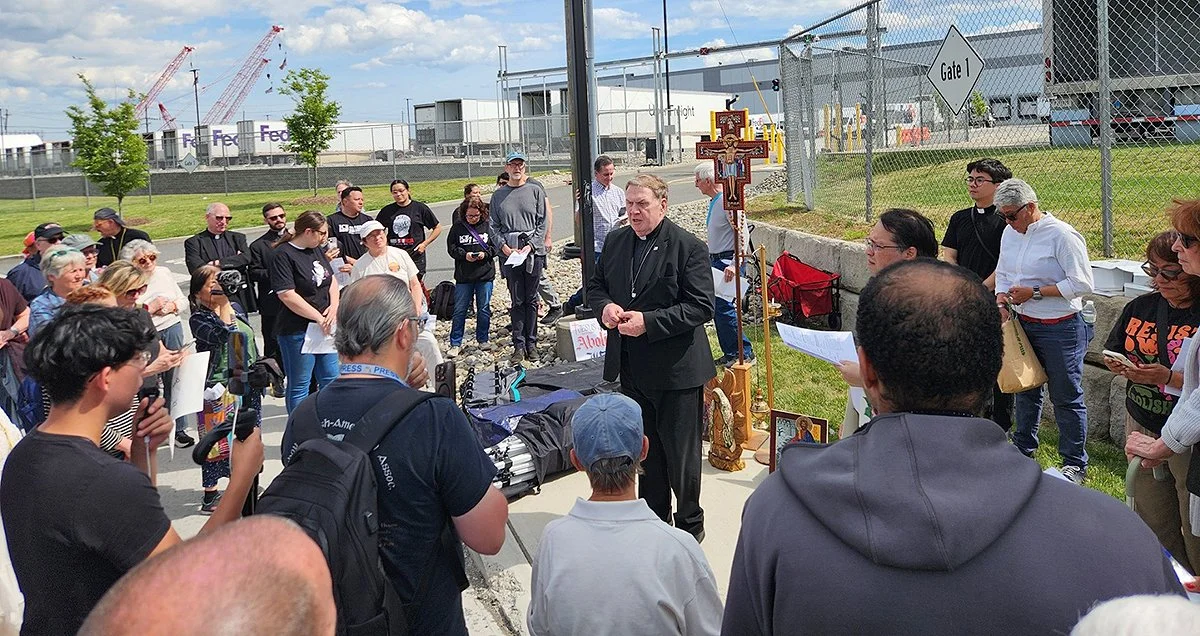
Cardinal Joseph Tobin, C.Ss.R. prays the Rosary with community at Delaney Hall.
As the number of detainees grew, so did the needs of their families. Breadwinners were locked up, and families were facing eviction. Word spread, and soon service organizations, congregations, and knitting clubs were volunteering their time and donating groceries and diapers. CSJP sisters and associates came to Delaney Hall to volunteer, to attend prayer vigils, and to distribute donated supplies. We got to know some of the families who would keep us posted on the deplorable conditions inside and on how their loved ones were faring. We hugged people bringing a change of clothing for loved ones about to be deported. We visited a few detainees who had no family here. When a detainee was released, we rang bells and celebrated with them.
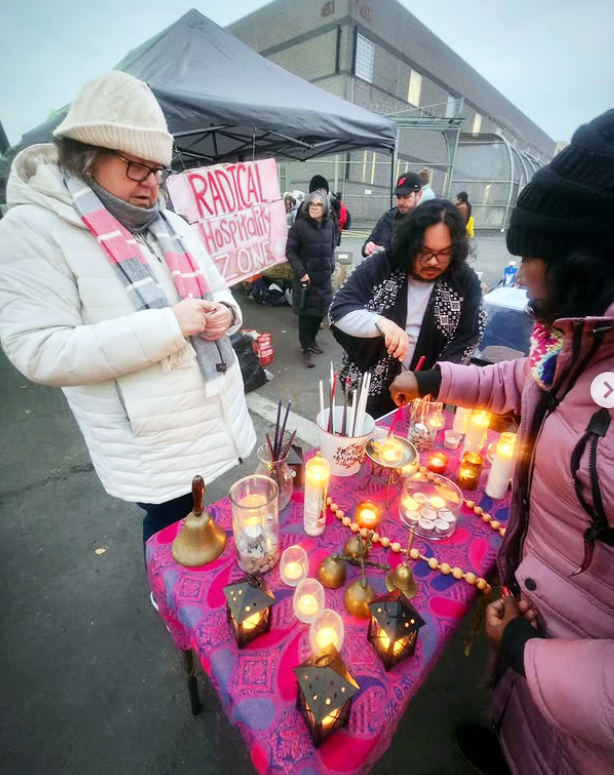
Susan Francois, CSJP.
Families still did not expect to wait outside in the driveway, so as the weather grew colder, we served hot coffee and put out the call for hats, gloves, coats and blankets. One of the regular visiting families sometimes brought Mexican hot cocoa and empanadas for the volunteers and families. Again, CSJPs and staff came through with cold weather supplies and prayers, donations and grocery gift cards. One day a volunteer brought food made by her next-door neighbor, who had been up all night cooking. She made the stew in the same pot that her mother had cooked back in Trinidad to feed hungry families in her own neighborhood.
In addition to supporting the families, we prayed with and for them and their loved ones. Every week, different Jewish, Christian, or interfaith groups would organize prayer services. We celebrated El Día de Los Muertos. Residents from a senior residence came for prayers and protests. We held vigils (in the snow) for those who had died in ICE custody. We gathered to pray the Rosary. Although the Rosary has never been a part of my daily life, communal prayer is important to me, so I was happy to take part. When I learned that a group of the detainees, who knew we were praying outside, gathered daily for the Rosary inside, its significance grew for me. I see the Rosary now as an act of solidarity with those held against their will, a unifying prayer across the prison walls.
Fifteen months into the immigration trauma of Delaney Hall, prayer is what I hold onto. It’s not a loud protest that brings media to spotlight injustices; it’s not an oversight visit that brings short term cosmetic changes to an unthinkable situation; it’s not a policy or cultural shift. But holding everyone affected in our loving hearts brings healing energy to the anguish our neighbors are suffering. It unites us in our common humanity and trains our hearts to hold the world.
This article appeared in the Autumn 2026 issue of Living Peace.