
By Melody Maravillas, Congregation CFO

Melody Maravillas, far left, with her family.
During my high school retreat, I received a palanca letter from my dad. “Palanca” is a Spanish word meaning lever and, in this context, is meant to “lift” or support one to be closer to God and is usually given to someone attending a spiritual retreat by friends, mentors or loved ones.
As a disciplinarian, his letter was true to form. It read like a mild scolding, hence my poor retention of the details. However, there is one message that I carry with me to this day: 小 心 (xiǎo xīn). Typically, it is a Chinese expression for “be careful” but in his letter, my dad referred to its literal meaning. It’s a reminder to live with a “small heart.” He defined the small heart as a humble heart. A counter to big egos; it never sees itself above others. Because it too is small, it sees others who are small, those who feel diminished, the disadvantaged, and the marginalized with empathy and compassion. While a small heart is careful, it does so out of mindfulness for others. Two words summed up one of the biggest lessons of my life.
Is there a role for a small heart in the Congregation’s economic ministry? In the areas of charitable giving and impact investing, it might seem counterintuitive. These are places for big hearts that are generous and giving. Yet, I will submit that small hearts have great capacity to build an economy of solidarity and subsidiarity. Such an economy “restore[s] to the poor what belongs to them” (Pope Francis, Evangelii Gaudium) and makes decisions “at the closest level possible to the persons involved, thereby fostering community life” (Pope Leo XIV, Magnifica Humanitas). For too long, money has been used to perpetuate systemic injustices and imbalances in power. It is the small heart that dispels the “savior complex,” seeks out the forgotten, and calls us to walk alongside each other, especially with those at risk of being left behind.
The small heart in action. For two years, CSJP had been supporting a program by Catholic Relief Services (CRS) called Changing the Way We Care, which provides safe spaces for children from high risk, low-income communities. It also strengthens and supports families economically and socially so that they are able to care for their children rather than turning to orphanages. However, like many nonprofits, CRS was deeply affected by the cuts in international aid, which had ripple effects on private donors.
Donors were becoming more selective, favoring certain projects, and increasing restrictions on what their funds could be used for. For example, CRS was three months away from completing a business skills training program for displaced people in Cameroon when international funding was cut. It had stalled right at the crucial juncture of providing small business grants and financial coaching to program participants.
CRS approached the Congregation for assistance. They needed a funding partner who was willing to pivot.
It was a carefully considered decision. If we shifted away from the Changing the Way We Care program to aid the business skills program, would that put services to children at risk? CRS assured us that the Changing the Way We Care program had sufficient funds to continue its work. Based on a long-standing, trusted relationship, we invited CRS to identify where funding was needed most.
This flexibility provided paths to livelihood for 300 families. Among them is a woman named Constance who fled the escalating conflict in her village. She shared: “There were heavy gunshots every day…. One night there was an attack and I had to flee.” CRS trained Constance on poultry farming techniques, and, through CSJP’s grant, she received 43 chicks, a chicken coop, and supplies to start a business. After selling the first batch, she used the proceeds to purchase more chicks. “Now I am brooding 82 chicks, and they are almost ready for sale. I am growing in the poultry business. I use the money I make to take care of myself, and I support my husband in his pork business.”
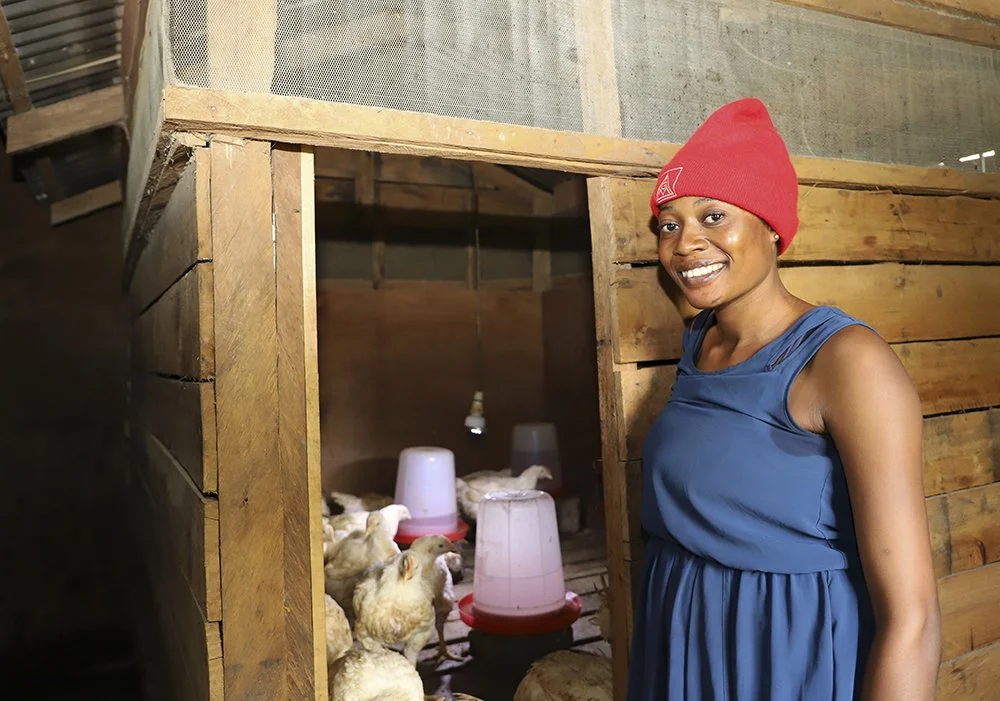
Constance. Photo by Mabel Chenjoh/Catholic Relief Services
Constance’s story is just one example of what a small heart can do. We become patient investors and agree to defer loan repayments so that communities in Ethiopia can fully reap the profits from their projects. We unite with the vulnerable and courageously call upon large corporations to respect and protect their human rights. We respond prophetically with gap funding to help charities stabilize their services for years to come.
With the overwhelming needs of these times, we often ask, “What is ours to do?” When we allow our relationships to reveal the answers, we can show up in ways where “services become more attuned to real needs, and solutions are more creative and respectful of the dignity of each person” (Pope Leo XIV, Magnifica Humanitas). In this way, the small heart, the humble heart, can be a catalyst for peace.
This article appeared in the Autumn 2026 issue of Living Peace.