
Excerpted from a chapter by Dr. Carmen M. Mangion for the book Committed Catholics Religious Involvement in Welfare after 1945, Anne-Sophie Crosetti & Juliette Masquelier (eds.)
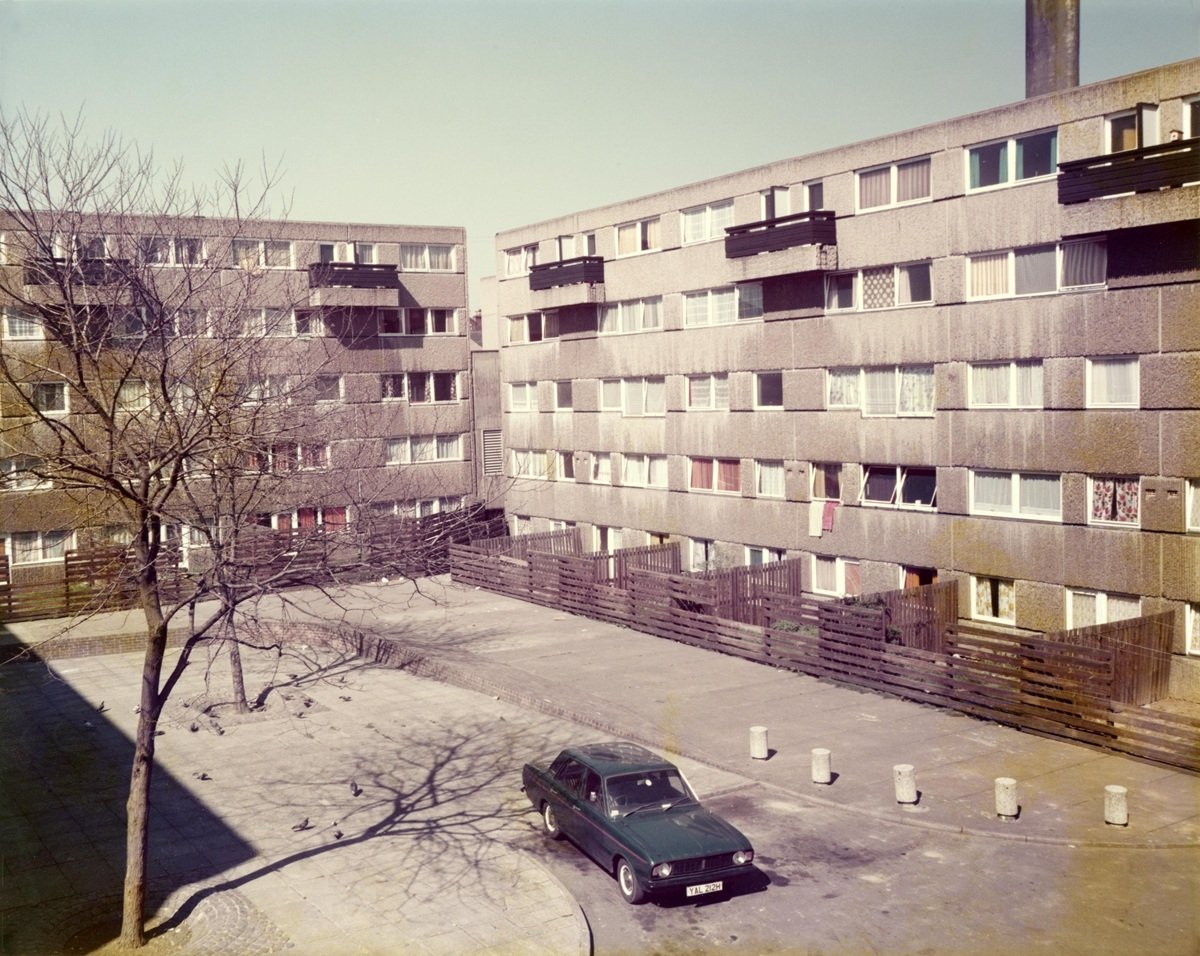
Hyson Green Flats. Credit: Nottingham City Council.
Hyson Green, a desperately impoverished area of Nottingham in the East Midlands of England, was, according to Andy Smart, a reporter for the Nottingham Evening Post, notorious for “crime, social unrest, poor housing and deprivation”. What was a “tight knit community” in back-to back terraced houses was replaced by the Hyson Green Flats (1965 1987), a “concrete jungle” of high-rise flats along a maze of corridors. Towards the end of the 1970s and into the 1980s, recession and high unemployment due to downsizing by local employers and “globalisation” (manufacturing overseas) of the textile industry had taken its toll. Riots in July 1981, on Radford Road adjacent to the Flats, caused even further devastation to local homes and businesses. Referred to by locals as “Sing Sing” (after the maximum security prison in New York), Hyson Green, adjacent to a red light district, had a reputation as an undesirable neighbourhood beset by social problems.
This unlikely location became the site of an experimental new ministry when two Catholic religious sisters from the Congregation of St Joseph of Peace (Rosemary Reilly, CSJP and Margaret Healy, CSJP) moved into a fifth-floor maisonette in January 1983. This ministry only lasted three years due to the demolition of the increasingly derelict Hyson Green Flats, but extant sources allow for a thick reading of how and why the two sisters responded to the Congregation’s aims of living “peace through justice”. Influenced by the “preferential option for the poor”, they inserted themselves among the marginalised, intending to “be with” more than “do for” the occupants of the Hyson Green Flats. In doing so, they discovered in the Hyson Green community a generosity that surpassed its negative reputation.
As a new form of religious ministry, “inserted communities” were hotly contested. Some claimed it as a “prophetic” ministry while others questioned its value. This was part of a pattern of women religious becoming “discreet presences in local life”, thus “being with” as well as being involved in advocacy work of “doing for”. Inserted communities were one of several post-conciliar responses of religious institutes to implementing the mission of the Church among those on the margins of society, intended as a means of returning power to the disenfranchised. Such ministries, be they drop-in centres for the homeless, drug rehabilitation facilities or support for asylum seekers, became opportunities for encounters that fostered an awareness of the lived experience associated with marginalisation and social exclusion that shaped their Congregation’s knowledge and emphasis on social justice.
Hyson Green, Nottingham

Sister Rosemary Reilly, CSJP.
Sister Rosemary Reilly selected Hyson Green Flats as the site of an inserted community. She retrained as a social worker to better meet the needs of single parent families in her day-to-day work at the St Joseph’s Mother and Baby Home.
Sister Rosemary proposed a new ministry where a community living near to these new mothers could provide practical hands-on advice on running a home, paying bills and coping alone with their baby. Sisters could help complete forms and claims for social security, teach young mothers how to budget within their weekly allowances, and provide links to public bodies that provided family and health-related services. She argued that such a community based near to where single mothers were housed would enable the mother to “maintain a decent standard of living and integrate herself into the community as a capable member”. Sister Rosemary also added a moral dimension to the proposal, suggesting that such a project would dissuade “vulnerable” young women from drifting towards “relationships which bring more problems”. The Catholic Children’s Society supported the venture, keeping her on their payroll until she was – within a year – employed by Nottingham Social Services as a social worker in Hyson Green.

Sister Margaret Healy, CSJP.
Sister Rosemary Reilly then applied to the Nottingham Housing Office and after several months was allocated a three-bedroom maisonette. The Hyson Green housing complex was comprised of 31 five-storey deck-access blocks connected by a maze of walkways that led from a concrete concourse to 122 flats and 471 maisonettes. Completed in 1968, it was touted as a state-of-the art solution to the housing needs of the area. But structural faults as well as water leakage, noise penetration and erosion of the prefabricated concrete elements meant by the late 1970s, the flats were run down; by the early 1980s they were the housing of last resort. In 1983, occupants came “top of the league for multi deprivation” in a Nottingham County study based on indicators including “low income, unemployment, lack of skills, poor housing and family problems”. Those who could left for better council housing; those who could not remained and lived mostly on state benefits. By the time Sister Rosemary’s application was accepted in January 1983, there were already a substantial number of empty dwellings.
Sister Margaret Healy joined Sister Rosemary in Hyson Green. Her role in the inserted community was to be a “good neighbour” who would involve herself in Hyson Green community life, join local self-help groups and be available to those who dropped by. She remained in the Hyson Green Flats for only eighteen months and left when elected Provincial of the Sacred Heart Province. Sister Deirdre Duffy replaced her and visited single-parent families and the elderly while working two days a week at St Aidan’s Hostel in Basford.
In September 1985, the sisters moved out of the complex. Hyson Green Flats were condemned as “constructurally [sic] unsafe”: by this time 350 of the 800 flats were empty. By 1988 the complex was demolished by Nottingham City Council. Sister Rosemary had hoped the work would be extended but opted not to be relocated to another council flat because she did not feel justified in competing for new housing with those with greater needs. Upon returning the keys to Nottingham City Council, Sister Rosemary had “feelings of sadness and regret” but also acknowledged the “rightness” of her decision.
This article appeared in the Autumn 2026 issue of Living Peace.